Friday, June 7, 2013

Undokai - Sports Day in Japan

Undokai (運動会), or Sports Day, is a special yearly event at Japanese schools in which students participate in athletic activities such as track races and various competitions. It's typically held on a weekend day during the spring or fall, and takes place on school playing fields. Teachers and students start preparing weeks in advance to ensure that everyone is ready, because the event attracts lots of spectators. Students' families including parents, siblings, and even grandparents come to watch and cheer for the children. Former students also often make appearances, to reminisce about their earlier school days, to see younger family members, or sometimes just to see old friends.

At my junior high school in Aomori City, Sports Day has always happened to fall on a bright, sunny Saturday morning. As customary in Japan, the event begins with an opening ceremony which includes a few obligatory speeches, bowing, and clapping. Next, everyone stands up and sings the surprisingly short but lovely national anthem (君が代, kimigayo). Lastly, the students quickly organize into lines for rajio taiso (ラジオ体操, lit. 'radio exercises'), which refers to warm-up calisthenics. This stretching routine is learned and memorized by all Japanese at a very young age, and besides promoting good health is also meant to raise morale and build group unity. Seeing hundreds of students performing these warm-ups simultaneously is quite a spectacle to watch. I also tend to catch elderly people doing it in the crowd as well, along with the students. Once the exercises are finished, the day's activities begin.


Here are the various races, activities, and competitions that take place during Sports Day at my junior high school:

1. Track Events (100m, 200m, 800m, Relay)
Track events make up a substantial part of Sports Day and include distances between 100 meters and 800 meters, as well as relay races. The vast majority of students put their full effort into these races and clearly take pride in winning. Along the track their respective teams admirably shout and cheer for their teammates to do their best.


2. TRY and Guru-Guru (TRYアングルグル)
One of the more lighthearted activities of Sports Day is a race called TRYアングルグル. Roughly pronounced like, "triangulu-gulu," it seems to me like it's a play on words for, "try and guru-guru." The latter word pair is just one of many Japanese onomatopoeia (擬声語, jiseigo), or words that sound like their meaning. In this context, "guru-guru" means, "spinning or revolving," and indeed it's pronunciation is supposed to mimic such an action. This activity starts with a baseball bat spin, where participants spin around a bat while placing their head on it to make themselves dizzy. Then they must make their way through some simple obstacles and finally to the finishline.

3. Magic Carpet (魔法のじゅうたん); also called Flying Carpet (空飛ぶじゅうたん)
The magic carpet race is performed by multiple teams simultaneously. The objective is to quickly reach a designated finish line while doing so on top of a large blue tarp, or "magic carpet." In order to accomplish this, several students tug the blue tarp forward while their 20+ teammates attempt to jump up and down in synchronous intervals. If timed correctly, the sheet can be pulled forward while all students are in mid-jump. [This event is exclusive to the first graders]


4. Team Jump Rope Competition (せいのうでぇーぽん, sei-nou-de pon, as it's called at my school)
The rules are very simple for this jump rope competition. Each team of approximately 35 students must achieve as many consecutive jumps as possible within two minutes. In regards to my school's name for this event, sei-nou-de pon is the equivalent of saying something like "1, 2, 3… jump!" [This event is exclusive to the second graders]


5. Human Centipede Race (恐怖のムカデ競争, lit. 'fearful centipede competition')
In this particular race, each team uses a single, long rope fitted with consecutive ankle loops which students step into forming a connected line, or "human centipede." While holding the shoulders of their classmates in front of them, students must coordinate their movements in order to jog forward in unison and reach the finish line as quickly as possible without falling. [This event is exclusive to the third graders]

6. Tug-of-War (色別対抗一文字綱引き, lit. 'Straight-line Tug of War by Opposing-colors Teams')
Traditionally, tug-of-war competitions involve two teams pulling opposite sides of a rope in an attempt to drag the opponent past a central point. But in Japanese junior high schools, the format is much different. Here, each team starts roughly 10 meters away from the rope and faces it perpendicularly on either side. When a starting pistol is fired, a mad dash towards the rope ensues as students try to grab hold of the rope as quickly as possible. The teams start pulling the rope towards their starting positions, where a flag is centrally located. The team team that successfully reaches their own flag--with any part of the rope--is declared the winner. [All grades participate in this event]


7. When to Borrow? Have a Meeting! (いつ借りるの?会でしょ!)
Similar to the Try and Guru-Guru activity, this is a more casually-inspired competition in which students are randomly directed to find one of their designated classmates to retrieve something while navigating a simple course and ultimately try to reach the finish line as quickly as possible.

8. Cheering Battle by Opposing-colors Teams (色別応援合戦)
This is one of the events that students prepare and practice for long in advance of Sports Day. All students of the school must participate in cheering groups, or oen (応援). In the competition, each group showcases a unique cheer performance or chants, dances, walking formations, drums, and a variety of colorful handmade items like pompoms or folding fans. Each team demonstrates their school spirit and cheers for their particular team (white, red, blue, and yellow at my school). Thus, these cheering groups are almost entirely unrelated to the Western notion of, "cheerleaders," but aren't meant to be in any way. It's a thoroughly entertaining event and good fun to watch.


By mid-afternoon, the final events wrap up and the closing ceremony begins. Trophies and awards are given out, and another round of speeches, clapping, and bowing ensues. As the student body stands in formation and listens to the speeches, it's a bittersweet moment for some. A number of students in their final year can be seen wiping tears from their faces as they realize it's their last Sports Day at his or her particular school. And frankly, it's easy to understand why--Japanese students make significant physical and emotional investments in these large school events. They are engulfed in school spirit and form great bonds with both their peers and their teachers.

When I was a student in the US, we also had a sports day (called, "Field Day") but it was entirely different in nearly every way imaginable. Of course it was very fun, and we certainly interacted with our friends and teachers during various athletic competitions like in Japan. Yet it felt smaller and less significant. It was also based on much more individual or small group activities rather than classes or large groups. For most students, there was basically no preparation leading up to the event for the US Sports Day. And although I believe the majority of students put some level of effort into most events, it didn't come close to that of Japan's Sports Day. In the States, it was a day we all looked forward to because we didn't have to study, we got to spend the whole day outside playing games with our friends, and we got to eat watermelon. In Japan, students and teachers prepare long and hard for it, they look forward to the real competitive nature of the event, and by the time it's over feel exhausted but have accomplished something important. Ultimately, I can look back to when I was a child and remember such fond memories of my Sports Day. But it's also great to see it here in Japan and realize just how different it is--like so many things I have the special opportunity to experience while living here.

Friday, May 31, 2013

Sakura - Japan's Beloved Cherry Blossoms

It was late afternoon on May 8th. I glanced at my watch anxiously then scanned the pale grey sky from the train's window. The sun had long passed it's midpoint in the sky and was slowly descending. Time was of the essence--I was adamant on getting to Hirosaki Park before the sun disappeared below the horizon. I reached the station, jumped off the train, and quickly bused to the famous park. As I walked toward to park gate, a gentle breeze caught the pearl-white pedals of sakura and they fluttered like butterfly wings. Even if only for one day, I made it.

Just outside the gate to Hirosaki Park
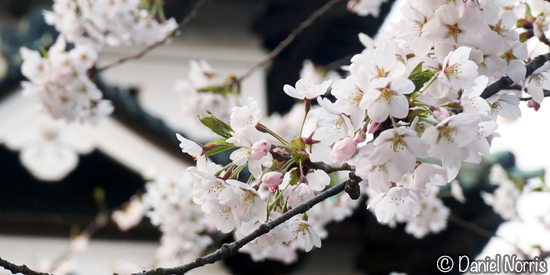
Sakura (桜), or cherry blossoms, are the beautiful white and pink flowers that burst out from Japanese Cherry trees every Spring. The opening and subsequent mankai (満開), or full bloom, starts as the weather gets warmer. In most of Japan, this is from late March in the South to the middle of May in the north. The exception is Okinawa, where the bloom happens in January! Where I live in Aomori, and specifically in the neighboring town of Hirosaki, the peak of full bloom occurred on May 8th this year--very lucky for me.

On the previous day, I had just returned from my wonderful two-week vacation and I was sure that I had missed the short lifespan of the celebrated flowers while away based on prior sakura forecasts. But there I was, strolling around in Hirosaki Park on one of the best viewing days of the year, an hour before nightfall. It was just enough time to appreciate the light, airy presence of thousands of enchanting cherry trees before the sun retreated for the evening. Yet even at night, viewing cherry blossoms at Hirosaki Park is just as impressive. Against the backdrop of Hirosaki Castle, the radiant-white flowers seem to glow in the darkness.

Great nighttime view in Hirosaki Park
Sakura is unquestionably one of the most significant elements of Japanese culture today. Every year, droves of Japanese families and friends make concerted efforts to enjoy the season by participating in hanami (花見), or cherry-blossom viewing. This traditionally involves picnicking under blooming cherry trees with lunch, sake (お酒, Japanese alcohol), and good company. Others simply walk around, snap photos, and enjoy the scenery. No matter how one decides to view the cherry blossoms, it's an incredibly worthwhile activity.

Visually, the flowers emanating en masse from the humble trees is a stunning sight to behold. Yet in Japanese culture, deeper meaning exists. From sprouting buds to stunning full bloom to inevitable death, cherry blossoms are thought to be a metaphor for the transience of life--which I essentially interpret as the notion that life is short and it will ultimately come to an end. This idea has been associated with the Japanese term, mono no aware (もののあはれ), which literally means, "the pathos of things." It's quite an interesting concept, in which an awareness of the ephemeral nature of all things will lead to a higher appreciation of their beauty. This seems quite simple but I can easily see how powerful such a perspective can be. It makes me wonder though, how well known these perspectives are to the younger generation in Japan. But at the very least, they can see imagery of sakura is everywhere in the country.

Hanami at Hirosaki Park
Whereas the opportunity to partake in cherry-blossom viewing is generally restricted to a mere two weeks every year, images, sounds, and tastes of sakura can be experienced daily in Japan. Cherry blossoms are a common motif found on kimonos (着物), the elegant traditional clothing Japanese people wear for ceremonies and other special affairs. It's very easy to find beautifully illustrated sakura in some of the oldest Japanese art as well as modern era pieces. Flip over any 100-yen coin, and you will see sakura. Go out for a night of karaoke and theres a good chance you'll hear songs about the lovely flower. Even KitKat has made a sakura-flavored version of their popular chocolate treats.

Monday, May 20, 2013

A Golden Getaway: Part 3 (Philippines)


The final destination of my trip was the Philippines, where my experiences were fascinating, relaxing, and often just plain fun. After a short layover in Macau, I proceeded to Manila’s Ninoy Aquino International Airport and arrived by late afternoon on Wednesday, May 1. Originally, I had no strong desire to visit Manila because this last portion of my trip was purely meant for relaxing on the beach. But since limited flights forced me to stay in the city for one night, I booked a hotel room and used the opportunity to explore the area a little.

For that one night, I stayed at a nice hotel that was ironically located in a poor area—a reminder of the stark contrast between rich and poor that’s prevalent in the country. Yet as I exited the hotel and walked down the streets, the atmosphere seemed particularly lively. Kids wearing ragged shorts were happily kicking a soccer ball around. Older women were sitting in ripped-up lawn chairs, chatting away. Others scurried about as if they were preparing for something. As it turned out, I happened to be there during Labor Day (Araw ng mga Manggagawà, in Tagalog), one of the most popular holidays in the Philippines.

As I continued down the roads, I spotted some sort of large complex called Ocean Park. I walked over and made a brief stop at a small hamburger stand where I bought two cheeseburgers for the equivalent of $0.50 USD each. The neighboring stand sold fantastic fresh mango smoothies so I was sure to grab one of those too. I could hear a music concert underway within the walls of Ocean Park, but it didn’t sound like anything special so I decided to keep walking. What I didn't know at the time is that it’s a world-class marine theme park; so unfortunately I missed out on it. However, I did randomly stumble upon a spectacular water, light, and music show at a massive nearby public park. 

Awesome light, water, music show at a local park in Manila
Cute little girl at the park
I starting snapping photos and sat down on a ledge for a rest when a half-dozen young children came running over to me. They had gleeful smiles on their faces and began asking me questions in their native language, Tagalog. I couldn’t understand what they were saying, but it was clear that they were excited. A young teenage girl then walked over and started talking to me in English. Seeing the way the kids reacted to her, I curiously asked if she was the mother of these kids as she chuckled and said, “No, of course not.” But just as I began to feel reassured she turned her head towards one of the children and in a straight face said, “but he’s mine!” The young girl was 14 years old; the boy was 4 years old.

Group of kids at the park
Over the course of the next hour, two-dozen kids had gravitated to me and it was fun but becoming a little overwhelming. A young woman also approached me and asked if I was looking for some fun. No thanks. I decided to call it a night and I headed back to the hotel. A couple blocks away from the hotel I started to see bright lights and loud sounds. It was a outdoor movie! The locals whom I had seen earlier had set up a fairly impressive movie night in a tiny park there. I thought it was really cool; it looked like the local community had just set this us for the night and all of the people I saw earlier were crammed in this little area, whether it was on benches, standing, sitting atop cars, whatever, they were there watching “Battleship” together.

Local neighborhood outdoor movie night near my hotel
The next morning I took a taxi to the airport, where I’d fly to Caticlan Airport on my way to Boracay. Traffic was horrendous but I left early so I figured it would be fine. I simply told the driver I needed to go to the domestic terminal. Once there, I went through security and looked for the check-in counter for my flight on Air Philippines. But I didn’t see it. It wasn’t there. Confused, I asked at the information desk about where I needed to check in. I was absolutely caught off guard to hear that the only flights from that terminal are on ‘Philippine Airlines’, not ‘Air Philippines’. My flight would be departing from the other domestic terminal, a totally separate building located 20 minutes away by taxi. I’m not sure how I could have known this earlier, as nothing about it was printed on my tickets or booking information. Thankfully, I still managed to catch my flight, albeit just barely.

From Manila to Boracay - by plane, motor tricycle, and boat
From Caticlan Aiport, I took a couple motor tricycles (trikes) and a ferry to get to the small, beautiful island of Boracay. I checked into my budget hotel, changed my clothes, and went directly to the beach. I stayed at a place on White Beach, which is considered to be the prime area on the island, where everything is located on a long beautiful stretch of white sand. After a quick swim in the crystal clear water, I watched a breath-taking sunset and then headed down the beach to where more of the action was taking place.

Incredible sunset in Boracay
I stopped at a great Mexican restaurant on the beach and sat down to eat some crunchy tacos. I met a cool couple from Australia who were also there and we shared some fun stories about our travels over a couple of cheap beers. A quick stroll from there, I checked out an outdoor dance club, also right on the beach. While walking to this area earlier, I had been swarmed by solicitors trying to sell island tours and water sports packages. So when a young Filipino man came up to me and asked where I was from, I skeptically asked what he was trying to sell. Although he wasn’t actually selling anything, I still thought he was a little strange so I was a bit unfriendly towards him. As he followed me and as we continued chatting, I just kept thinking that he had some agenda. Even when he later asked if he could take a picture with me, I declined. Later I did warm up to him a little, and we went to a few different bars and clubs. But looking back at that night, I realize that he truly just wanted to be my friend. Frankly, I feel a little badly about the way I treated him because it's unlike me to be so cynical (another lesson learned). Nonetheless, I enjoyed my first night and the next few days were only going to get better.

My vision of vacation in the Philippines consistently made me think of relaxing on the beach during the day and enjoying some nightlife in the evening. And I’m happy to say, that’s exactly what I did. Every morning I woke up whenever I felt like it, ate breakfast, then went for a swim in the ocean. I took photos, explored the island a little, drank delicious fruit smoothies, ate lunch, took a nap on the beach, went swimming again, and watched the sunset. Afterwards, I’d stop at the hotel for a nice shower then head out for the nightlife. I did the same thing in various combinations through my days here, and I loved it. If I was traveling with friends I would have liked to do island hopping or more water sports, but I was content with taking it easy as I was there solo.

Enjoying the beach!
My second night in Boracay was on Friday. I ate a big, fat, juicy burger then went to a club in station 1. There, I met a group of super nice, mid-20’s Filipinos with whom I hung out with for most of the night and had a super fun time. As the club heated up--literally and figuratively, the dj pulled out a hose and sprayed everyone in the crowd as everyone shouted and jumped up and down with the beats. Needless to say, it was a really fun atmosphere. As the night progressed we also went to a couple more clubs. By the end of the night we ended up at Epic, one of the most popular clubs on White Beach. At some point in the night, I felt like taking a nap on the beach. I woke up a few hours later, lying in the sand as the sun was rising and the waves were gently hitting the shore. I know it sounds pretty funny, but it was in fact a stunningly peaceful way to start the day.

Saturday night was probably my best night in Boracay as I got to see both Zedd at Club Paraw and Swanky Tunes at Epic, dj live. Club Paraw built a large custom addition to their existing club for the exclusive event. Tickets were extremely limited and I didn’t have any. But I was fortunate to met a young man and his friends right before the show who let me go with them since they had an extra ticket. Just standing in the line to get in was absolutely crazy. Once we finally got in, we danced our way to the stage, right in front of the DJ. The music was pounding, the lights were blazing, the crowd was electric, singing and dancing to every song. It was an amazing experience for me. Zedd finished his set around 2:30 A.M., and then we walked over to Epic where we got to see Swanky Tunes dj until sunrise.

Zedd live at Club Paraw, Boracay (screen capture from video)
For my fourth and final night in Boracay, I took it easy and didn’t drink or party. Instead, I found a quiet section of the beach and watched the stars for several hours. Stargazing there was spectacular since it’s so dark over the ocean and there are no major cities nearby. I really enjoyed this, and even managed to see a few stunning shooting stars. Later I took a stroll and met a group of nice Taiwanese students while ordering a mango smoothie. I also made my way over to some fire performers and watched that for a while, as well as to take a couple photos with them. 


Fire poi performers
Lastly, I loved the tacos so much from my first night that I had to get them again before returning to the hotel for a good night of sleep. Ironically, I had a terrible nightmare that I was in a deadly plane crash so I can't say it was all that good of sleep.

Indeed, the next day I had to take four separate flights to get back home in Aomori. Two of those flights, happened to have bad turbulence. But alas, I made it back safely. I'll admit, there were a few unpleasant aspects to Boracay; I grew so exhausted of the hundreds of solicitors calling to me, "hey, my friend.... jet skiing, parasailing, boat tours... I'll give you good price!". Dude--I'm not your friend, stop calling me that. And nightly I was was randomly approached by... various individuals who, "just want to have fun". But my experience there was so amazing that it's really easy to look past these negatives. Ultimately I absolutely loved my trip of my tropical excursion in the Philippines immensely and I really hope I can make it back there soon!